
CRM Strategy: Plan and Optimize Customer Relationship Management

A CRM strategy defines how your business finds, wins, and keeps customers over time.
CRM (Customer Relationship Management) strategy is often misunderstood as a software decision. It is not. Buying a license for Salesforce or HubSpot will not fix a broken sales process on its own. Without a plan, a CRM becomes nothing more than an expensive digital rolodex.
So what actually makes a CRM work?
Why do some teams scale smoothly while others drown in data?
And who really owns the customer once the deal is closed?
For founders and revenue leaders, the stakes are real. A strong CRM strategy aligns marketing, sales, and support into a single system with shared goals. It removes data silos and creates accountability across the full customer journey, not just individual handoffs.
If you want your CRM to drive growth instead of collect dust, keep reading. This guide breaks down the structure, thinking, and execution behind a CRM strategy that actually works.
What is a CRM?
A CRM, or customer relationship management system, is a tool that helps businesses manage relationships with both potential and existing customers from one central platform. It brings customer information, communication history, and activity tracking into a single place so teams always know where things stand.
Modern CRM systems go beyond basic data storage. They help create personalized sales and marketing campaigns, support customer service interactions, and use AI to suggest next steps or opportunities. With everything connected, businesses can manage the full customer journey across marketing, sales, commerce, support, and even IT.
One of the biggest advantages of using a CRM is having a single source of truth. Every team works from the same customer data, which reduces mistakes, delays, and frustrating handoffs. For customers, this means smoother experiences and more relevant interactions at every stage.
When used thoughtfully, a CRM benefits both sides. Businesses gain better visibility and efficiency, while customers receive more consistent and personalized service. Like any business tool, the real value comes from having a clear strategy behind how it is used.
What Defines a Comprehensive CRM Strategy?
A CRM strategy is a company-wide plan to manage customer interactions, distinct from the software itself. It aligns business goals, customer journey maps, and data governance to improve relationships and revenue. It dictates how technology supports the process, not the other way around, ensuring every touchpoint adds value to the customer lifecycle.
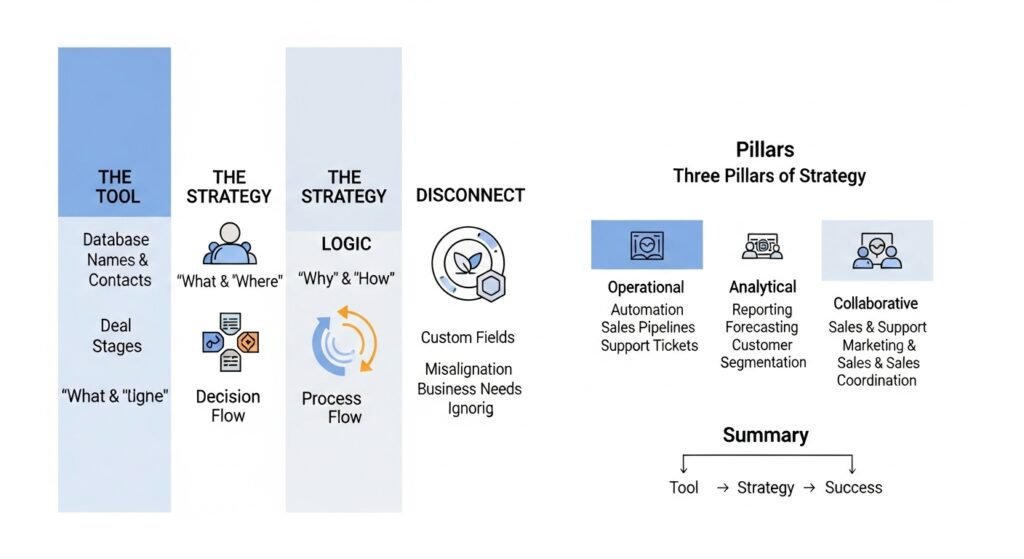
The Distinction Between Tool and Strategy
Buying a hammer does not build a house. You need blueprints.
- The Tool: This is the database. It stores names, phone numbers, and deal stages. It handles the “what” and the “where.”
- The Strategy: This is the logic. It handles the “why” and the “how.” Why do we collect this specific data point? How does a lead move from marketing to sales?
- The Disconnect: Most failures happen because companies implement the tool without the strategy. They customize fields based on what one manager wants today, rather than what the business needs tomorrow.
The Three Pillars of Strategy
Your plan must address three specific areas.
- Operational: How we do the work. This covers automation, sales pipelines, and support tickets.
- Analytical: How we measure the work. This covers reporting, forecasting, and customer segmentation.
- Collaborative: How we share the work. This covers how sales talks to support and how marketing talks to sales.
How Do You Select the Right CRM Framework?
A CRM Framework provides the structural foundation for your strategy, categorizing activities into operational, analytical, and collaborative pillars. It ensures that your technology stack supports specific business functions—like sales automation or customer support—rather than creating disconnected silos of data that confuse employees and frustrate customers.
Operational Frameworks
This focuses on efficiency. If your primary goal is to help sales reps close deals faster, your strategy focuses on Operational CRM. You build workflows that automate data entry. You prioritize mobile access for field reps. You ensure that the quote-to-cash process is fast.
Analytical Frameworks
This focuses on intelligence. If your goal is to understand customer behavior, you prioritize CRM Data Analysis. Your strategy defines how you warehouse data. You decide which metrics (CAC, LTV, Churn Rate) matter most. You build the system to capture clean data points that feed your business intelligence tools.
Why Is the CRM Life Cycle Central to Planning?
The CRM Life Cycle dictates how you treat customers at different stages: acquisition, retention, and loyalty. Your strategy must define specific workflows for each stage, ensuring marketing nurtures leads, sales closes deals, and support retains accounts. Ignoring this lifecycle results in a leaky funnel and high churn rates.
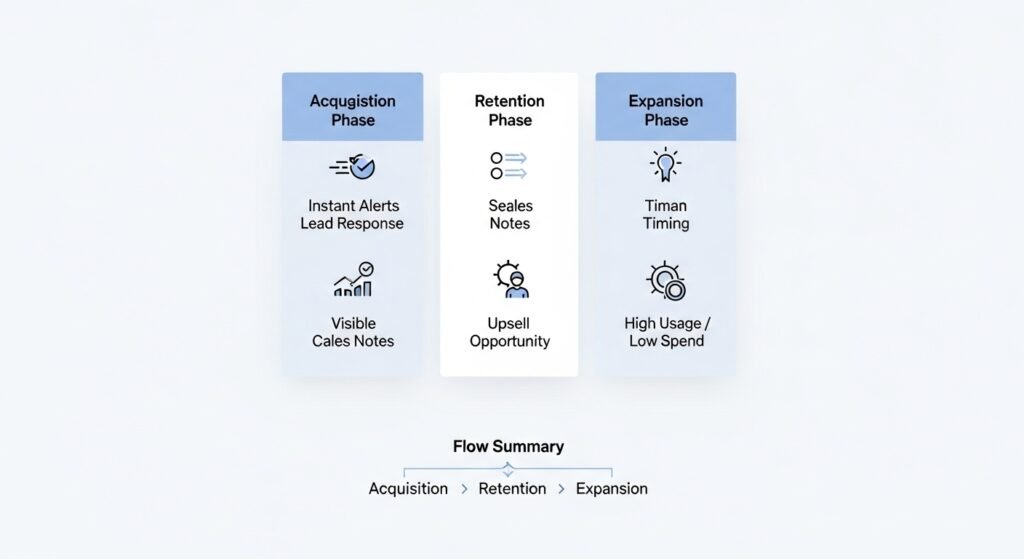
Mapping the Journey
You cannot treat a prospect the same way you treat a 10-year client.
- Acquisition Phase: The strategy here is speed. How fast can we respond to a lead? The CRM must trigger instant alerts.
- Retention Phase: The strategy here is service. Does the support team see the sales notes? If a customer calls with a problem, the agent needs context.
- Expansion Phase: The strategy here is timing. When do we ask for the upsell? The system should flag accounts that have high usage but low spend.
Who Should Be Involved in the Steering Committee?
A CRM Steering Committee governs the strategy, composed of stakeholders from sales, marketing, IT, and finance to ensure cross-departmental alignment. This group meets regularly to review user adoption, prioritize feature requests, and ensure the system evolves with the business rather than becoming a static legacy tool.
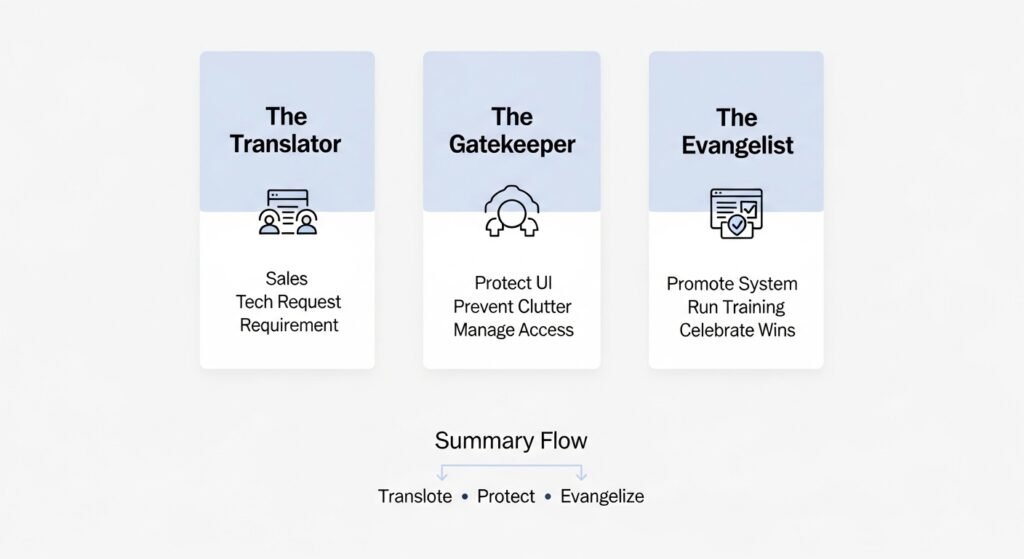
The Role of the CRM Manager
You need a specific owner. The CRM Manager is not just an admin resetting passwords. They are the product owner of your revenue engine.
- The Translator: They speak “Sales” and they speak “Tech.” They translate a sales manager’s request (“I need to see who is slacking off”) into a technical requirement (“Build a ‘Last Login’ report”).
- The Gatekeeper: They say no. If every department gets every field they want, the system becomes unusable. The Manager protects the user interface from clutter.
- The Evangelist: They sell the system to the internal team. They run training sessions and celebrate wins.
How Do You Define Data Governance Protocols?
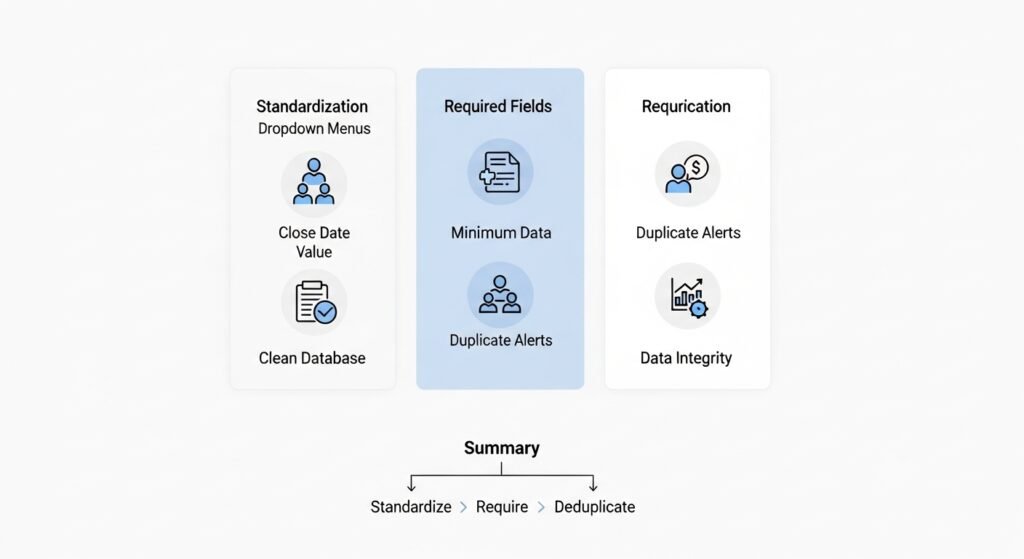
Data governance protocols establish the rules for data entry, maintenance, and access, ensuring that the information inside the system remains accurate and actionable. Without strict governance, the database quickly fills with duplicates and incomplete records, leading to a loss of trust among users who refuse to rely on “dirty data.”
The “Garbage In” Prevention Plan
- Standardization: Do not use free text fields for things like “Industry.” Use a dropdown menu. If one rep types “Tech” and another types “Technology,” your reports break.
- Required Fields: Define the minimum viable data. A rep cannot create an Opportunity without a Close Date and a Value.
- Deduplication: Set up rules to catch duplicates. If a rep tries to add “John Smith at Acme,” the system should alert them that “J. Smith at Acme Corp” already exists.
How Do You Plan for Integrations?
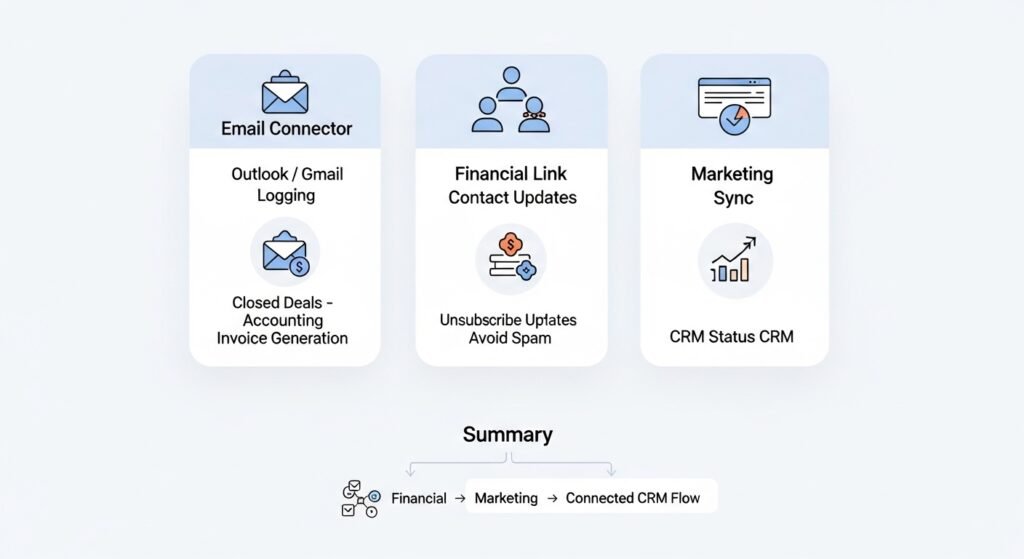
A robust integration strategy utilizes CRM Integration Tools to connect the CRM with your ERP, email marketing, and customer support platforms. This eliminates manual data entry and ensures a “single source of truth,” allowing data to flow bi-directionally between systems so every department sees the same customer reality.
The Connected Ecosystem
Your CRM cannot live on an island.
- The Email Connector: This is non-negotiable. Emails sent from Outlook or Gmail must log automatically to the contact record.
- The Financial Link: When a deal closes, it should push to the accounting system (QuickBooks/NetSuite) to generate an invoice.
- The Marketing Sync: If a lead unsubscribes from the newsletter, that status must update in the CRM so the sales rep doesn’t spam them.
When Should You Hire CRM Implementation Services?
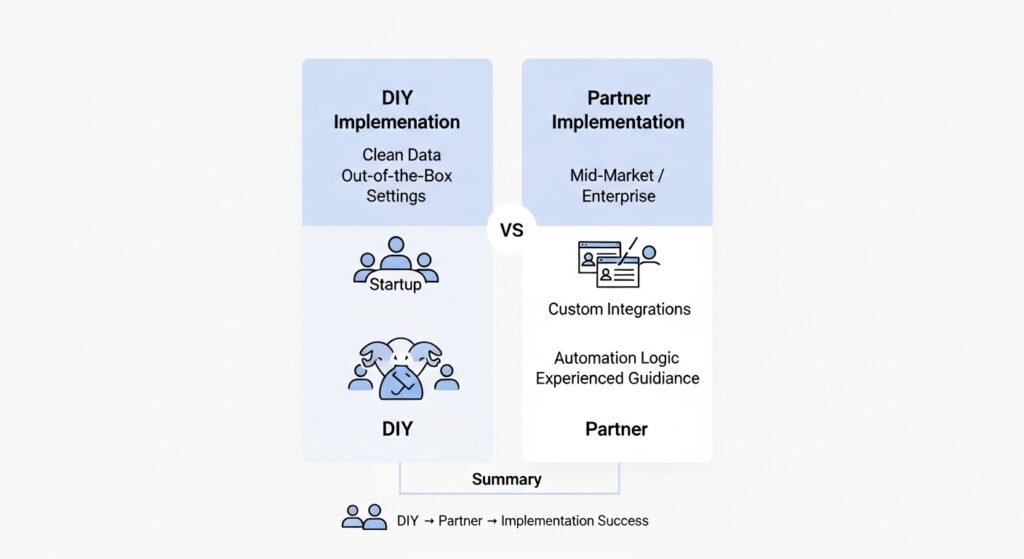
You should hire CRM Implementation Services when your deployment involves complex data migration, custom coding, or enterprise-level change management needs. While small teams can often self-implement simple tools, larger organizations risk failure without external experts to guide the architectural decisions and enforce project timelines.
The Build vs. Buy Decision
- DIY Implementation: Good for startups with <10 users and clean data. You use the out-of-the-box settings.
- Partner Implementation: Essential for mid-market and enterprise. You are paying for their scars. They have seen every mistake and can steer you around them. They build the custom integrations and the complex automation logic that you don’t have the skills to build in-house.
How Do You Drive User Adoption?
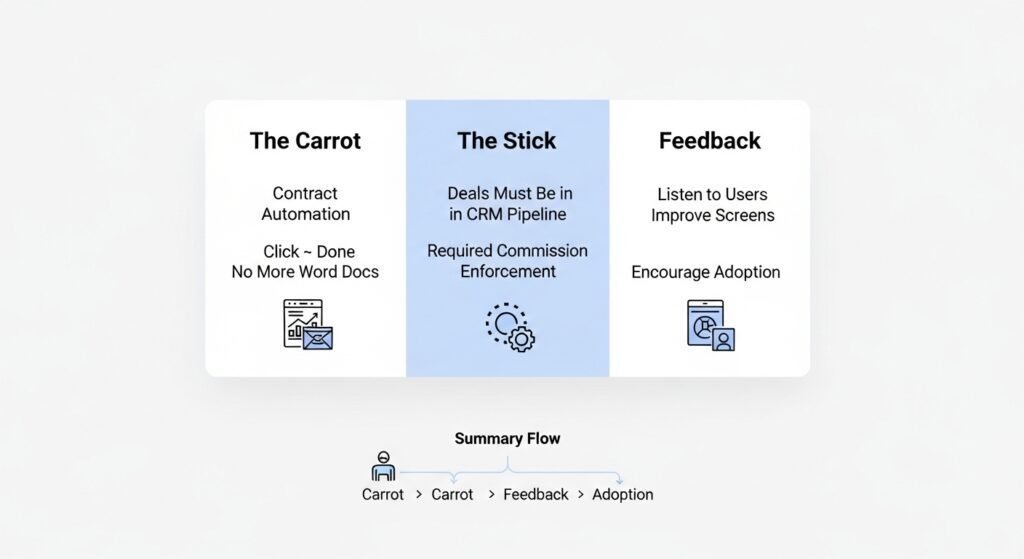
User adoption relies on the “WIIFM” principle (What’s In It For Me), demonstrating to users that the system saves them time rather than just monitoring their work. Successful strategies include gamification, simplifying the interface, and tying commission payouts directly to data accuracy within the CRM.
The Stick and the Carrot
- The Carrot: Show the sales rep that the CRM automates their contract generation. “If you put the data here, you click one button and the contract is done. No more Word docs.”
- The Stick: “If it isn’t in the CRM, it doesn’t exist.” If a deal isn’t in the pipeline, you don’t get paid commission on it. This is harsh but effective CRM Management.
- The Feedback Loop: Listen to the users. If they say a screen is too hard to use, fix it. If they feel heard, they will use the tool.
What Metrics Measure Strategy Success?
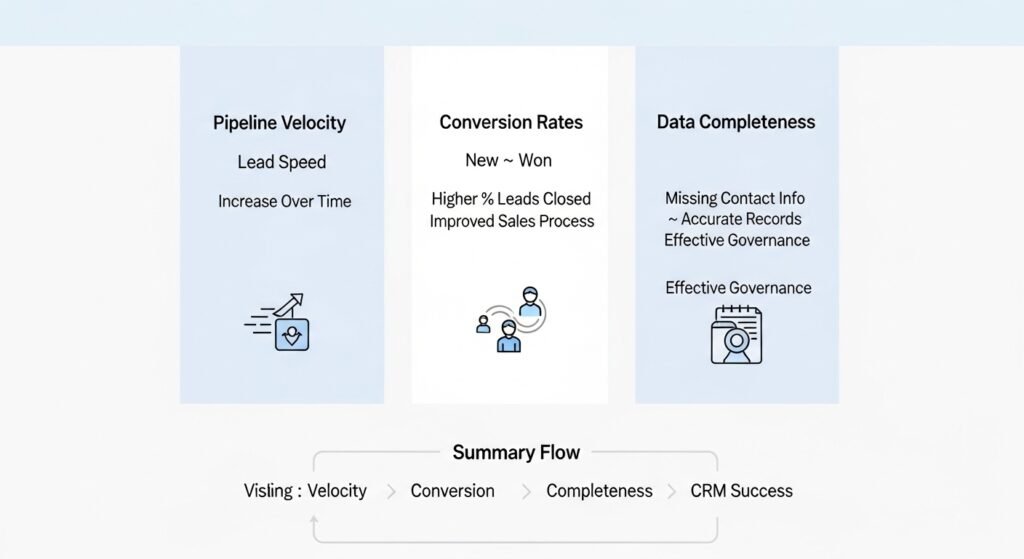
Success metrics should focus on business outcomes like pipeline velocity, conversion rates, and customer retention costs, rather than vanity metrics like “login frequency.” A successful strategy reduces the time it takes to close a deal and increases the lifetime value of the customer, proving a tangible ROI on the software investment.
Moving Beyond Activity
- Pipeline Velocity: How fast does a lead move from “New” to “Won”? If the CRM strategy is working, this speed should increase.
- Conversion Rates: Are we closing a higher percentage of leads? This means marketing is sending better data and sales is following a better process.
- Data Completeness: Run a report on “Percentage of Contacts with Missing Phone Numbers.” If this number drops, your governance strategy is working.
Comparison of Strategy Focus Areas
| Focus Area | Primary Goal | Key Stakeholder | Success Metric |
| Operational | Efficiency | VP of Sales | Time to Close |
| Analytical | Intelligence | CFO / Analyst | Forecast Accuracy |
| Collaborative | Satisfaction | Head of Support | Net Promoter Score (NPS) |
| Strategic | Long-term Value | CEO | Lifetime Value (LTV) |
Conclusion
A CRM Strategy is a living document. It evolves as your business grows. The plan you built for 10 employees will break when you have 100. You must constantly revisit your framework, audit your data, and listen to your users.
For the business leader, the mandate is clear: Stop looking for a magic software bullet. The magic is in the process. The software is just the engine; you are the driver. If you don’t know where you are going, a faster engine just gets you lost quicker.
Build the plan. Clean the data. Train the people. Then, and only then, trust the tool.