
What Are the 4 Types of CRM? Explained with Examples

Types of CRM define how businesses manage customers, data, and daily interactions.
But here is where things get confusing. Not all CRM software works the same way, and choosing the wrong type can slow teams down instead of helping them grow.
So how many types of CRM are there?
Why do some focus on automation while others focus on insights or collaboration?
And which one actually fits your business needs?
There are four main types of CRM systems. Operational CRM helps automate sales, marketing, and customer service. Analytical CRM focuses on analyzing customer data for insights. Collaborative CRM makes it easier to share customer information across teams. Strategic CRM centers on long-term relationships and customer loyalty.
Understanding these types of CRM software helps you choose the right tools, avoid wasted features, and build better customer experiences.
Keep reading to explore each type of CRM with clear examples and see how different CRM software supports real business goals.
What is CRM?
Customer relationship management, or CRM, is a way to organize and manage every interaction your business has with customers and prospects in one central place. Instead of customer information living in separate tools or departments, a CRM brings everything together so sales, marketing, and support teams all work from the same data.
At its core, CRM software stores customer details and tracks relationships across the entire journey, from first contact to purchase and long term loyalty. But modern CRMs do much more than act as a database. They help teams send sales emails, run marketing campaigns, support customers efficiently, and create personalized buying experiences.
Today’s CRM platforms often include built-in AI. These AI agents can automatically qualify leads, recommend next actions, launch campaigns, and suggest products based on individual customer behavior. They work continuously in the background, learning from every interaction and improving over time, often without needing manual input.
By keeping teams aligned and customer information accurate, CRM systems make it easier to build stronger relationships, reduce friction in daily work, and make smarter business decisions. Simply put, a CRM helps businesses understand their customers better and grow in a more organized, profitable way.
What Are the 4 Types of CRM?
CRM systems are commonly grouped into four main types that help businesses manage customer data and interactions. These categories provide a framework for organizing your daily tasks, analyzing your results, and coordinating your team efforts. You use this list to identify which functional area your business needs to focus on most.
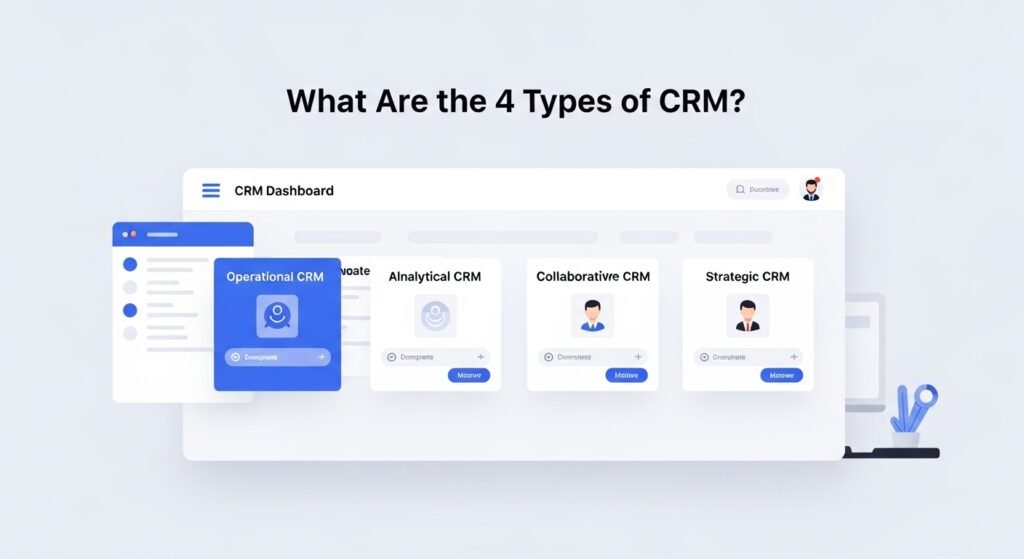
The 4 Types of CRM:
- Operational CRM
- Analytical CRM
- Collaborative CRM
- Strategic CRM
Each type serves a unique purpose in your business system. You do not just use them as separate tools; you use them to support different parts of the customer journey. This list helps you see the focus of each system. You can evaluate your current operations against these types to find the best fit for your team’s needs.
What Do CRM Types Represent in a Business Context?
CRM types represent different business priorities that guide how you manage your customer relationships and internal data. You see these categories as functional focus areas that determine which parts of your business you want to improve. They ensure that your technology matches your specific goals, such as speeding up sales or finding deep data insights.
You should view these types as different lenses for your business. One lens might focus on the speed of your daily work, while another looks at the patterns in your customer behavior. Most companies find that they use more than one type as they grow. By understanding these priorities, you can build a more balanced business. You use the types to align your team’s actions with your overall strategy. They turn your scattered tools into a coordinated system for long-term success.
What Is Operational CRM?
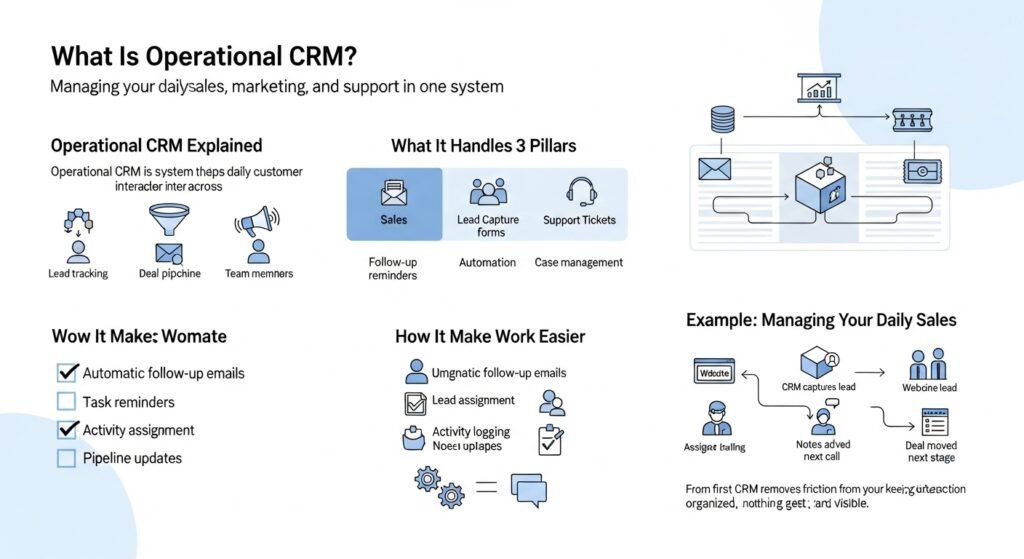
Operational CRM is a business system focused on managing day-to-day, customer-facing activities like sales, marketing, and support. You use this type to streamline your routine tasks and ensure that your team works efficiently. It provides the structure you need to track every interaction from the first lead to the final purchase.
You want to make your daily work easier and more accurate. This system automates your busy work, such as sending follow-up emails or setting meeting reminders. It gives your team a clear view of their pipeline so they know what to do next. By using an operational approach, you remove the friction from your sales process. You make your business run like a smooth machine that never forgets a lead.
Example: Managing Your Daily Sales
You use an operational system to capture a new lead from your website. The system automatically assigns that lead to a sales rep and sets a task for a phone call. When the call is over, the rep logs the notes and moves the deal to the next stage. This ensures your sales path is clear and fast.
What Is Analytical CRM?
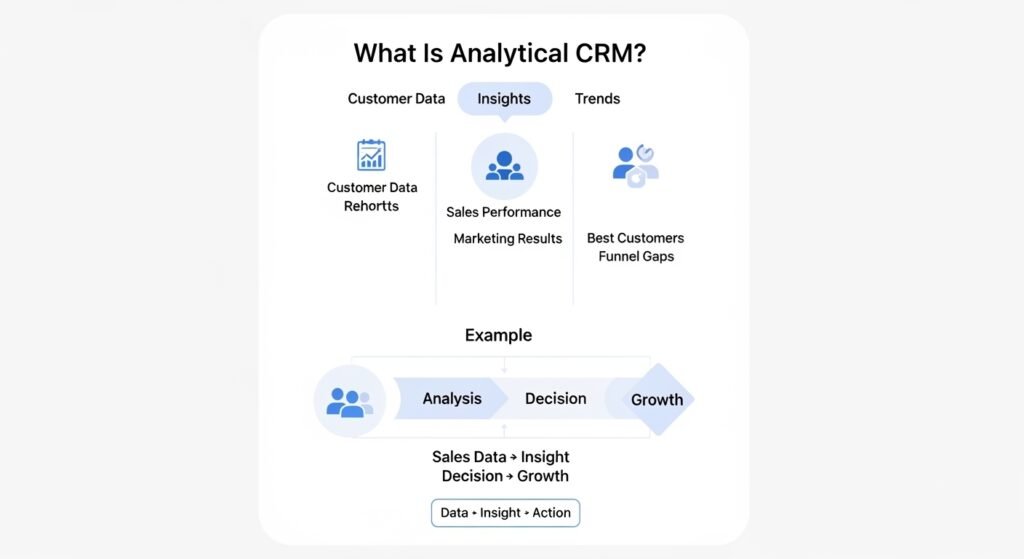
Analytical CRM is a business system focused on collecting and studying customer data to find patterns and generate insights. You use this type to understand your performance and to make better choices based on real-world facts. It helps you see the “why” behind your sales numbers and customer behaviors.
You stop relying on your gut feeling and start relying on data. This system looks at your history to tell you which customers are your best buyers. It shows you where people are dropping out of your sales funnel. You use these facts to improve your results. By focusing on analysis, you lower your risks. You know exactly where to spend your budget to get the best return. You turn your database into a strategic guide for your future growth.
Example: Understanding Customer Behavior
You use an analytical system to run a report on your last 100 sales. You find that customers who watch your video are 50% more likely to buy. You decide to put that video on your home page. This choice is based on hard data, which leads to more profit for your brand.
What Is Collaborative CRM?
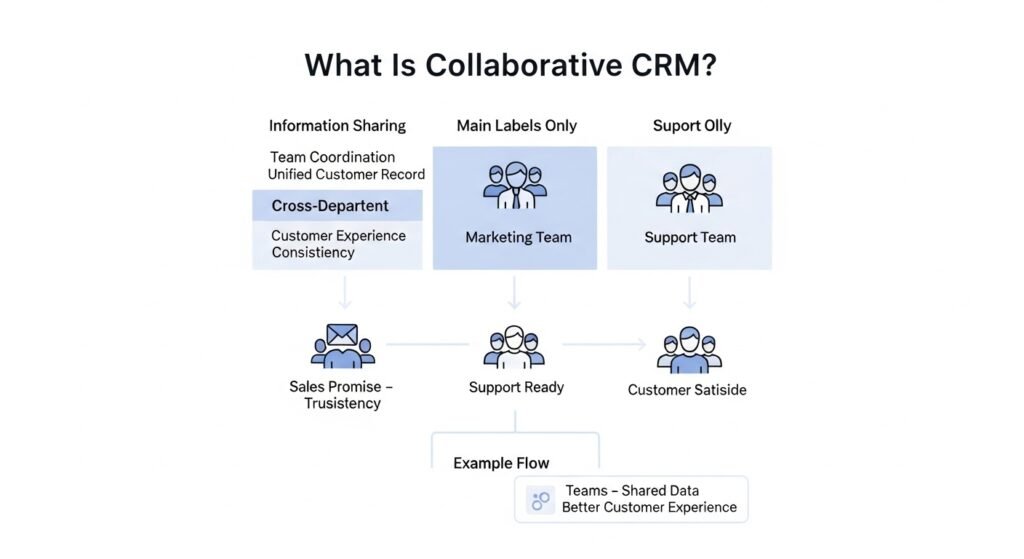
Collaborative CRM is a business system designed for information sharing and coordination across your different departments. You use this type to ensure that your sales, marketing, and service teams all work from the same customer record. It removes the walls between your staff and creates a unified experience for the buyer.
You want your customer to feel like they are talking to one single company. This system makes sure that when a client calls support, the rep sees what the sales team promised. No one has to ask the same old questions. Everyone stays on the same page. By focusing on coordination, you build deep trust with your audience. You look professional and reliable. You use the system to bridge the gap between your team members, making your company move as one.
Example: Coordinating Sales and Support
Your sales rep closes a deal and makes a specific promise about a setup date. Your support team sees that note instantly. When the customer calls to ask about the setup, the support rep already has the answer. This speed and accuracy make the customer feel valued and respected.
What Is Strategic CRM?
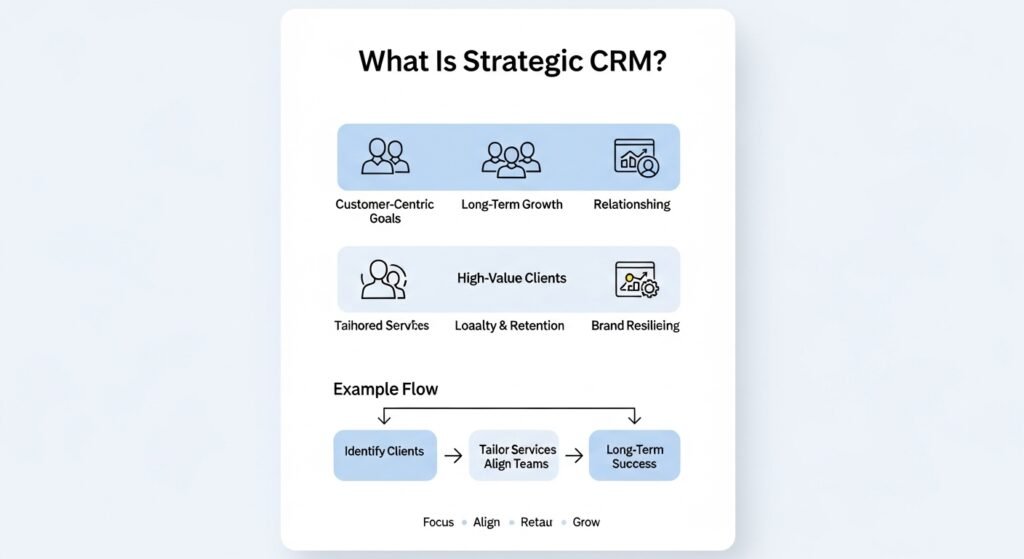
Strategic CRM is a long-term business approach focused on building and maintaining customer-centric goals. You use this type to align your entire company with the needs and values of your most important clients. It is about creating a culture that puts the relationship at the center of every decision you make.
You focus on the lifetime value of your customers. This approach helps you identify which clients are worth the most to your brand over several years. You then tailor your services to keep those people happy and loyal. By using a strategic focus, you build a foundation for stable, long-term growth. You are not just looking for the next sale; you are looking for a partner. This makes your brand more resilient in a competitive market because your customers feel a deep bond with your business.
Example: Aligning with Long-Term Goals
You decide to focus on high-value clients in the healthcare industry. You use your strategic system to find these clients and offer them a specialized service plan. You align your marketing and sales to speak their language. Over time, you become the top choice for that specific group, ensuring steady income for years.
How Do the Types of CRM Work Together?
The types of CRM often overlap in real businesses to create a complete and coordinated customer management system. You use operational tools for your daily tasks, analytical tools for your reports, and collaborative tools for your team meetings. Your strategic approach then guides how you use all of these together.
You should not view these types as mutually exclusive. A professional setup usually combines elements of all four. You might start with an operational focus to get your leads organized. As you grow, you add analytical features to see your trends. You then ensure your teams are collaborating through shared data. Finally, you use your strategy to refine your whole process. This combined usage gives you the most power. You get the speed of automation, the wisdom of data, and the strength of a unified team.
| CRM Type | Main Focus | Business Benefit |
| Operational | Daily tasks and sales | You save time and work faster |
| Analytical | Data patterns and trends | You make smarter choices |
| Collaborative | Team coordination | You provide a unified experience |
| Strategic | Long-term relationships | You build lasting customer loyalty |
How Should Businesses Choose the Right CRM Type?
Choosing the right CRM type depends on your business priorities, your current maturity, and the specific problems you want to solve. You should focus on the area where you feel the most pain. If your sales are messy, you need an operational focus. If you are losing customers but don’t know why, you need an analytical focus.
You should evaluate your team’s daily needs. Do they struggle with follow-ups? Start with an operational system. Do they work in different offices? Look for collaborative features. You do not need to buy the most complex tool available. You need the one that fits your actual work. As your business grows, your needs will change. You can then add more capabilities. The key is to pick a system that can grow with you. Start with what matters most today and build your foundation for tomorrow.
What Are the Key Takeaways About the Types of CRM?
The four types of CRM provide a framework for managing your daily tasks, analyzing your data, coordinating your team, and setting your long-term strategy. By understanding these categories, you can pick the right tools to support your business growth. You use these types to build a professional, customer-centric brand that wins more trust and profit.
- Operational: Manages your daily sales and marketing tasks.
- Analytical: Turns your raw data into clear business insights.
- Collaborative: Ensures your teams share the same customer info.
- Strategic: Aligns your company with your long-term relationship goals.
Are the 4 types of CRM used separately or together?
You usually use them together as parts of one system. Most modern tools include features from all four types. You might focus more on one area depending on your goals, but they all work together to support your customers.
Which CRM type is best for small businesses?
Operational CRM is usually the best place to start. You need to get your leads and sales organized first. Once you have a steady flow of data, you can start using analytical and collaborative features to grow your brand further.
Can one CRM system support multiple CRM types?
Yes, most professional CRM systems are built to support all four types. You can choose which features to turn on and which ones to ignore. This flexibility allows you to customize the system to fit your specific business logic.
Is strategic CRM the same as CRM strategy?
No, strategic CRM is a type of system focused on long-term relationships. CRM strategy is your overall plan for how you will use any tool to reach your goals. You need a strategy before you can use any type of CRM effectively.
How do CRM types relate to the customer lifecycle?
They support different stages. Operational CRM helps with awareness and acquisition. Analytical CRM helps you see how to improve retention. Collaborative and strategic CRM ensure a smooth journey into expansion and advocacy.
What happens if a business focuses on only one CRM type?
You might get gaps in your service. If you only focus on operational tasks, you might miss the big trends in your data. If you only focus on analytics, your daily sales might be messy. A balanced approach is usually the most stable path to success.
Comparing CRM Process vs CRM Components
When building your business system, you must understand the difference between your process and your components. Your CRM process is the set of steps your team follows from lead to loyalty. Your CRM components are the actual tools and functional parts, like lead management or reporting, that you use to perform those steps.
You can think of it like building a house. The process is the blueprint that shows the order of work. The components are the materials you use, like the wood and bricks. You need both to succeed. If you have a process but no components, you have a plan but no tools. If you have components but no process, you have tools but no plan. By aligning your 4 types of CRM with your process and components, you create a professional and coordinated brand.
Refine Your CRM Content Strategy
You now have a clear view of the different ways to manage your customer data. You see that your choice of CRM type depends on your business goals. You must use this framework to build a company that is organized, smart, and coordinated.
Your next step is to evaluate your current tools. Which type are they focused on? Are you missing any key areas like analytics or collaboration? Use the four types as a checklist to find your weak spots. Once you fix those gaps, you will see your team become more efficient and your customers become more loyal. You have the power to turn your data into your biggest business asset. Start mastering the 4 types of CRM today and watch your stability and profit grow.