

What an AI Bubble Burst Means for AI CRM Tools

Many economists and analysts are warning that the huge amount of money going into the current AI boom could be a bubble, and that it might burst. This matters for anyone using or buying CRM software, since so many CRM tools now market themselves around AI features like predictive lead scoring and AI writing assistants.
If you have shopped for a CRM lately, you have probably noticed that almost every platform talks about AI. Predictive lead scoring, AI email writing, smart forecasting. It is everywhere. This kind of rapid growth is often called the AI boom, and at the same time, you may have seen news stories asking if the AI bubble is about to burst. That raises a fair question for any business owner picking software. If the AI bubble does burst, does that mean the AI features you are paying for could disappear or stop improving?
This guide breaks that question down in simple terms. We will explain what an AI bubble burst actually means, why it connects to the software you use every day, and how to tell if a CRM’s AI features are built to last or are just hype. Along the way, we will look at real vendors like HubSpot, Zoho, Salesforce, and Freshsales to show what sustainable AI features look like in practice.
What Does “AI Bubble Burst” Actually Mean?
An AI bubble burst would mean that AI-related company values and spending drop sharply after growing much faster than the actual profits or usefulness those companies can show. This kind of drop is called a bubble bursting.
A bubble happens when excitement about something pushes its price or value up much faster than what it is truly worth. At some point, reality catches up, and the value falls quickly. This has happened before with other new technologies, most famously during the dot-com bubble in the early 2000s.
Right now, some of the biggest tech companies in the world are spending massive amounts of money on AI infrastructure. This is often called AI capex, which is short for capital expenditure. Analysts have pointed out that hyperscaler spending, meaning the spending done by giant cloud companies, has grown incredibly fast in a short amount of time. Big banks and research groups, including the Bank for International Settlements (BIS) and Goldman Sachs, have both raised concerns about how sustainable this spending is.
Well known investor Jeremy Grantham has also said publicly that he expects the AI bubble to burst at some point, comparing it to past waves of overinvestment in new technology, like railways or the early internet.
None of this means AI itself will disappear. Even after the dot-com bubble burst, the internet did not go away. It means some companies and some AI-related spending could slow down or get corrected, while the core technology keeps improving in the background.
Why AI Spending Trends Affect the Software You Buy
Big AI infrastructure spending might feel like a distant Wall Street story, but it actually connects directly to the software tools your business relies on every day, including your CRM.
Many AI features inside modern CRM software rely on generative AI models and cloud computing power that is built and paid for by large tech companies. When those companies pour huge amounts of money into building AI capacity, it eventually shows up in two places for regular software buyers.
It Can Affect SaaS Pricing
SaaS pricing, meaning the subscription cost of software as a service, can shift based on how much it costs a company to run its AI features behind the scenes. If a CRM vendor pays a lot to use powerful AI models, some of that cost may eventually get passed along through price increases.
It Can Affect Which AI Features Actually Stick Around
Not every AI feature a vendor adds is meant to last forever. Some are added quickly to keep up with competitors, almost like a trend, rather than because they solve a real, lasting problem. If AI investment slows down and companies become more careful with spending, some of these trend-driven features may get quietly removed or stop being updated.
This is exactly why understanding the difference between real AI value and simple AI hype matters so much when you are choosing software.
Will AI Features Disappear From CRM Tools if the Bubble Bursts?
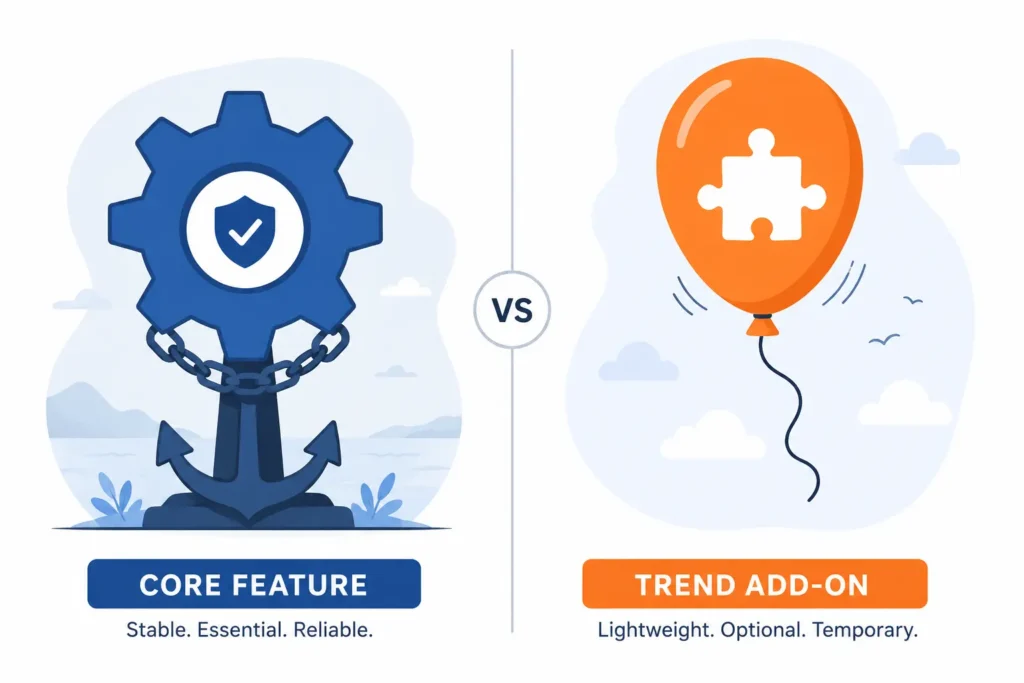
Most core AI features already built into major CRM platforms, like predictive lead scoring or automated data entry, are unlikely to disappear completely, even if AI spending slows down. However, newer, less proven, or heavily marketed AI add-ons are more at risk of being cut or scaled back.
It helps to think of CRM AI features in two categories.
Built-In, Core AI Features
These are features that are deeply built into how the CRM works day to day. A good example is Freshsales, which uses a feature called Freddy AI to score leads automatically based on how engaged they are. This kind of feature has been refined over time and is central to how the product works. Vendors are unlikely to remove core features like this, since doing so would hurt the product itself, not just a marketing bullet point.
Bolt-On or Trend-Driven AI Features
These are AI features added quickly, often to match a competitor or to look modern in marketing materials. They may not be deeply tested, and they may depend heavily on outside AI providers rather than the vendor’s own technology. If AI costs rise or investment slows, these features are more likely to be quietly discontinued, limited, or moved behind a more expensive plan.
Why Vendor Size and Ecosystem Matter
Large, well-established CRM vendors like Salesforce and Zoho tend to have more resources and a wider ecosystem of products, which makes them more able to absorb changes in AI costs without cutting features suddenly. Smaller or newer AI-only add-ons are the ones most likely to be affected if the broader AI funding environment tightens.
How Can I Tell if a CRM’s AI Features Are Real or Just Hype?
You can tell the difference between real AI value and simple AI hype by checking whether a feature solves a clear, specific problem, whether it has been part of the product for a while, and whether the vendor explains how it actually works rather than just using buzzwords.
This is often called avoiding AI washing, which means labeling a feature as “AI-powered” mainly for marketing purposes, even when the actual benefit is small or unclear.
Use this simple checklist when evaluating any CRM’s AI powered CRM risks before you buy.
- Ask what problem it solves. A strong AI feature should have a clear answer, like “it tells you which leads are most likely to buy” or “it writes a first draft of a follow-up email.” If the answer is vague, be cautious.
- Check how long it has existed. Features that have been part of the platform for a year or more, with visible updates, tend to be more trustworthy than something added in the last few months.
- Look for real examples, not just buzzwords. A trustworthy vendor will show you an actual example of the AI feature working, not just say “powered by generative AI” without details.
- Notice if it depends on ChatGPT or another outside AI provider. This is not automatically bad, but it does mean the feature’s future cost and performance are partly tied to that outside provider.
- See if it is included or a costly add-on. Features bundled into a plan you already pay for tend to be more stable than expensive extra add-ons that could get cut if a vendor tightens its budget.
How to Choose a CRM That Won’t Leave You Stranded
Choosing a CRM with sustainable AI features means focusing on the platform’s overall strength first, and treating AI as one helpful part of the picture rather than the main reason to buy.
This approach protects you no matter what happens with the wider AI bubble burst conversation.
Start With the Fundamentals, Not the AI Features
Before looking at AI at all, make sure the CRM handles the basics well. Does it organize your contacts clearly? Does it support your sales pipeline the way your team actually works? A CRM that is strong on fundamentals will still be useful even if some AI extras change over time.
Look at Total Cost of Ownership, Not Just the AI Price Tag
Total cost of ownership means looking at everything you will actually pay over time, not just the advertised monthly price. Some vendors charge extra as your contact list grows or lock advanced AI features behind expensive plans. Understanding this now helps you avoid surprise costs later if pricing shifts as AI costs change industry-wide.
Avoid Vendor Lock-In Where Possible
Vendor lock-in happens when it becomes difficult or expensive to switch away from a platform later. Choosing a CRM that allows you to export your data easily and integrates with common tools protects you if you ever need to change platforms because a vendor’s AI strategy shifts in a direction that no longer fits your needs.
Favor Platforms With a Track Record
Established platforms like HubSpot, Zoho, and Salesforce have years of steady development behind their AI features, along with large customer bases that keep them accountable. This does not mean newer tools are bad, but it does mean well established platforms carry less risk if the broader AI funding environment changes.
Final Thoughts
The conversation about an AI bubble burst is really a conversation about how fast AI spending has grown, and whether that pace can continue. For CRM buyers, the smartest response is not to panic about AI features disappearing overnight. Instead, focus on choosing software with strong fundamentals, a track record of steady AI development, and clear, provable value behind every AI feature it offers. A CRM built this way will serve your business well, whether the AI bubble bursts, slows down, or keeps growing.
If you are comparing CRM platforms and want to see how the top options stack up beyond just their AI features, explore our full CRM comparison to find the right fit for your business.
Frequently Asked Questions
Is AI in CRM software overhyped?
Some of it is, and some of it is not. Established features like predictive lead scoring have real evidence behind them, while some newer AI add-ons are more about marketing than proven results. It is worth judging each feature on its own rather than assuming all AI claims are equal.
Will AI features disappear from software I already use?
It is unlikely that well established, core AI features will disappear suddenly. Vendors are more likely to slow down new AI feature development or discontinue less popular add-ons than to remove tools that customers already rely on daily.
What is AI washing?
AI washing means labeling a product or feature as “AI-powered” mainly for marketing appeal, even when the actual AI involved is minor or the benefit is unclear. Reading real examples of how a feature works helps you spot this.
Should I avoid CRMs that rely on generative AI or ChatGPT integrations?
Not necessarily. Many useful features, like AI-assisted email writing, rely on generative AI providers. The key is choosing a vendor that uses this technology to solve a clear problem, rather than adding it only as a marketing checkbox.
How is the current AI bubble burst conversation different from the dot-com bubble?
Both involve fast investment growth followed by concerns about a correction. Like the dot-com era, most experts expect the underlying technology, in this case AI, to keep existing and improving even if some companies or spending levels correct sharply.
Does a CRM’s AI feature list matter more than its core functionality?
No. Core functionality, like contact management, pipeline tracking, and ease of use, should always come first. AI features are a valuable bonus, not a replacement for a CRM that handles the basics well.